
Meeting booking as art - Fredrik Hellstrand's secret pitch to fill your calendar
You are sitting in your office on a Thursday morning. Your salesperson has just called his 23rd potential customer this week. The phone hangs up after 15 seconds. You ask him what he said. He shakes his head: "I'm not quite sure. It felt right when I said it."
This is the problem with meeting booking in most sales organizations. There is no strategy. There are just... vibes.
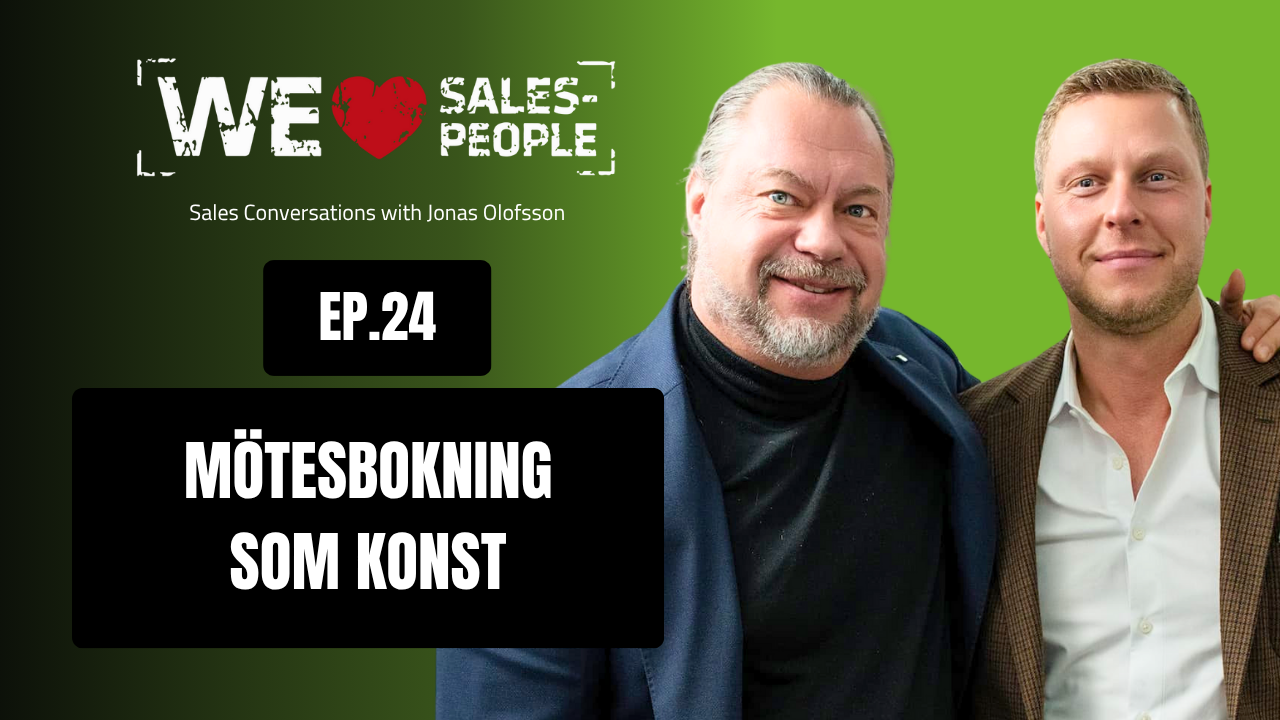
Fredrik Hellstrand has spent years building sales cultures that actually deliver. He understands the frustration deeply. And in his latest conversation with Jonas Olofsson on the "We love salespeople" podcast, he shares three fundamental insights that can transform how your sales team books meetings.
In the conversation, Fredrik shares several invaluable strategies. Here are 3 of the insights you don't want to miss:
1. Your phone isn't dead - you're just too scared to use it
Every sales manager tells us that "appointment booking has changed". LinkedIn, email, automation, video. It's true that the options are there. But here's the truth that few dare to say out loud:
The telephone is still the most efficient way to book meetings.
Fredrik has data on this. Adviser Partner has tested, measured and documented it. And yet - almost no one uses it consistently.
"I still feel today, the phone has lived on in all my roles and companies, as the most efficient way to get in touch," says Fredrik. But he hastens to add something critical: that doesn't mean you ignore other channels. You complement them. The phone is the base.
And why is that? Because it takes courage to call. It is personal. It cannot be automated. And that's why it works.
What you can do: If you're not actively using your phone today, start from here. Not as a main strategy - as a foundation. Test it for two weeks. Measure the results. You will be surprised.
2. Your Sales Manager Can't Teach Others How to Do It - And That's a Problem
Here is the irritant
The truth: most sales managers can book meetings themselves. They do it well. But can they teach it to their team?
Almost never.
"It doesn't know... you can know how to do it. But that doesn't mean you understand why it works or exactly how to do it," Fredrik explains, referring to something he calls the ladder of knowledge.
There are seven steps on this staircase, but we usually stop at step two: "I know how to do it myself." We run on auto-pilot when we make a call. We have developed instincts.
The problem is that instincts don't scale. Your best salesperson can do it perfectly. But can he explain it to three other colleagues in a way that allows them to reproduce the same success?
Probably not.
"You can do it, but you have to do it your way. But that way may not work at all for others," says Fredrik and identifies the actual cytotoxin in many sales organizations: lack of documented process.
What you can do: Sit down with your top meeting bookers next week. Ask these questions: What do you say when someone answers? What is your first goal? What do you do if they say no? Write it down. That's now your meeting booking pitch. It is now something that can be learned.
3. Your Meeting Invitation Makes or Breaks the Meeting - Way Before It Starts
You have done the job. Your pitch worked. The potential said yes. You send the meeting invitation.
And then what? It gets forgotten. It gets sandwiched between 47 other meetings on the calendar. Or worse - it gets thrown into spam.
Fredrik is worried about this. Very worried. Because the meeting invitation is not just a calendar item - it's your last chance to build interest and trust before the meeting starts.
"There are two things that are important," he says. "Interest and trust."
Interest is created by clearly demonstrating why the meeting is worth 60 minutes of their life. Trust is built through verification: who are you, what have you done before, what similar companies have you worked with?
And here's the detail that few people talk about: the subject line.
"The subject line is important," says Fredrik simply. "It's the first thing you say in the calendar."
Most people just write "Meeting" or "Conversation with [company]". Fredrik writes something that actually creates relevance. Something that says: this meeting creates value for you.
Example: Instead of "Meeting - Adviser Partner" write: "Increase sales - explore opportunities with Adviser Partner and [other similar businesses]."
Is it longer? Yes, it is. Is it worth it?
"I think that spending the extra 37 seconds on the meeting invitation is seconds well invested," says Fredrik.
What you can do: Create two or three variations of meeting invitations - with different subject lines, different purpose statements, different testimonials. Use signatures/templates in your email blast. Pilot which one works best. Then - standardize it.
This is just a fraction of the knowledge Fredrik shares. Want to hear the full conversation, get more concrete examples and dive deep into meeting booking strategy, sales team management and how to transfer knowledge in your organization?
Do you and your sales team want the tools to implement these strategies and reach new levels? Adviser Partner helps you build a sales culture that performs. We combine proven methodology with practical coaching to transform your sales team. What started as "We love salespeople" is now a complete sales development platform.
Get in touch with us to learn more about our proven Way of Sales methodology - and how we can implement it in your organization this month.