
Your technicians are your best salespeople—they just don't know it yet
Imagine a service company with 30 electricians working in the field. Every day, they meet hundreds of customers, visit their homes, assess their needs, and enjoy a level of trust that most traditional salespeople can only dream of. Yet they leave every visit without even trying to make a sale. Not because they can’t—but because no one has taught them how.
It is this paradox that Dennis Ekvall has dedicated his career to solving. With a solid background in the copy-shopping industry—one of the most activity-driven and competitive sales environments out there—he now works to help companies in the skilled trades and service industries unlock the sales potential that already exists within their organizations, albeit under a different job title.
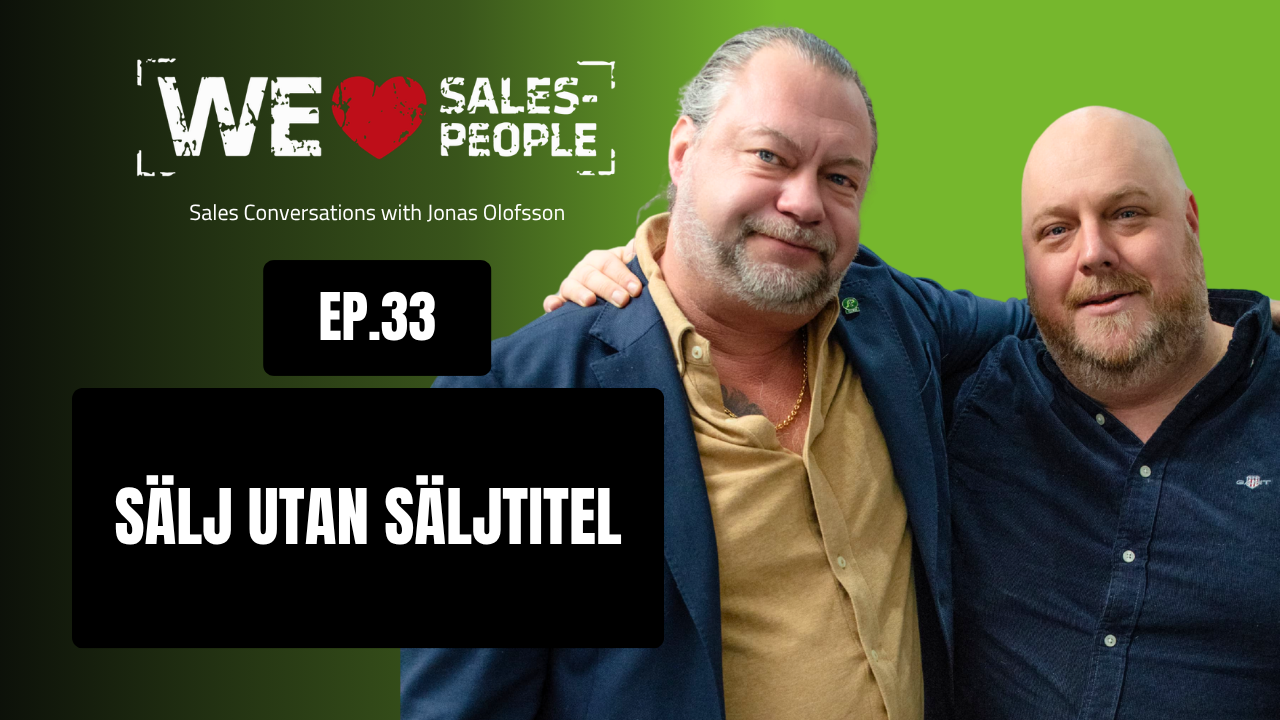
In the latest episode of We Love Salespeople, Dennis sits down with Jonas Olofsson for a conversation full of practical insights into what it really means to train non-salespeople to sell—and why it’s easier than most people think.
In the interview, Dennis Ekvall shares several invaluable strategies. Here are 3 insights you won’t want to miss
1. Trust is your hidden selling point
There is a fundamental difference between a traditional salesperson and a tradesperson who interacts with the customer: trust. A salesperson has to work hard to earn it. A tradesperson who has done a good job already has it.
Dennis points out that non-salespeople often hold a trump card that’s worth its weight in gold but never play it—precisely because they don’t see it as a sales situation. The electrician who installed your charging station, the plumber who fixed the leak, the service technician who was on site last Friday: they all have a deep reservoir of trust. It just takes a little curiosity and a simple question to turn that trust into more business.
"Build trust. That’s what we as salespeople must do too—build trust with the customer. And that’s the foundation of everything."
This aligns well with Adviser Partners’ Way of Sales methodology, which emphasizes trust as the foundation of all referral sales. Trust is built on character and competence—the willingness to do the right thing, and the ability to prove that you can actually do it. The combination of these two factors ensures that the customer not only makes a single purchase but also becomes an ambassador.
2. The Pilot – Start Small and Think Big
One of the most common mistakes when training non-salespeople is trying to win everyone over at once. Dennis recommends a much simpler strategy: start with the pilot.
Identify the 10–20 percent of employees who are genuinely curious and motivated. Train them. Let them achieve results. And then let those results spread organically throughout the organization. Dennis describes how, in a project with an excavator company, he had the most interested excavators go door-to-door in the neighborhood—and how those who were initially uninterested suddenly wanted to join in when they saw that their colleagues were earning an extra 15,000 kronor in just a couple of weeks.
"You don't have to win everyone over at once. It's enough to win over the most interested people—to create a positive momentum within the company."
The key is to combine the pilot with what Dennis calls “financial logic”: showing exactly what the change is worth in dollars and cents. When a CEO sees that 30 technicians handling three extra assignments per week generate millions in new revenue, the conversation takes a completely different turn.
3. Stop leaving money on the table – close the deal
The third major theme of the conversation revolves around a mistake that costs small businesses enormous sums of money every year: the fear of closing a deal. Technicians and tradespeople do an excellent job, identify a clear need on the customer’s part—and then wrap things up by saying, “Let us know when you’re ready.” Then they leave.
Dennis is clear: it’s not about being pushy. It’s about helping the customer make a decision they’re already leaning toward. The fear of coming across as pushy is, in the vast majority of cases, an illusion. Dennis asks a simple but revealing question to those he trains: “Have you ever been kicked out by a customer?” The answer is almost always no—which proves that they aren’t even close to going too far.
"Just close the case. That's where many, many people go wrong. They leave things open—and leave money on the table."
In the Way of Sales methodology, this is a core principle: trust, combined with facts, benefits, and value (explaining what the product or service actually does for the customer), creates the conditions for a natural close. It’s not about manipulation—it’s about helping the customer see the value and take the plunge.
Next Step
This is just a fraction of the insights Dennis Ekvall shares. Want to hear the full conversation, get more concrete examples, and dive deeper into how you can train your non-sales staff to become part of your sales engine? Listen to the full episode of We Love Salespeople here!
Would you and your sales team like to have the tools to implement these strategies and reach new heights? Adviser Partner can help you build a high-performing sales culture. Contact us at expansion@adviser-partner.se or visit www.adviser-partner.se to learn more about our proven Way of Sales methodology.